We trust healthcare professionals to provide competent and safe care. But what happens when that trust is broken, and a medical error causes harm? Understanding your rights and knowing where to turn is crucial. This article explores medical malpractice and explains how a skilled attorney specialising in this area can help you pursue justice.
Understanding Medical Malpractice: When Medical Care Goes Wrong
Medical malpractice occurs when a healthcare provider’s negligence results in injury to a patient. It’s more than just a bad outcome; it involves a deviation from the accepted standard of care. This standard represents the level of skill and care that a reasonably competent healthcare professional in the same field would provide under similar circumstances.
Consider this: a surgeon accidentally nicks a major artery during a routine gallbladder removal, leading to severe bleeding and requiring additional surgeries to repair the damage. Or, imagine a doctor misdiagnoses a patient’s early-stage cancer, delaying treatment and allowing the disease to progress to a more advanced, less treatable stage. These scenarios, unfortunately, are examples of potential medical malpractice. The National Practitioner Data Bank receives thousands of reports of medical malpractice payments annually, underscoring the prevalence of these issues.
Identifying Potential Medical Negligence: Signs You Need a Medical Malpractice Lawyer
Recognising potential malpractice can be challenging. It’s essential to remember that a poor result doesn’t automatically equate to negligence. However, certain red flags should prompt you to seek legal advice:
- Unexplained complications: Experiencing unexpected complications after a procedure, especially if they seem disproportionate to the procedure’s risks.
- Deviation from standard protocols: Awareness that a healthcare provider didn’t follow established medical protocols.
- Lack of informed consent: Undergoing a procedure without a clear understanding of the risks, benefits, and alternatives.
- Significant delays in diagnosis or treatment: Suspecting that a delayed diagnosis or treatment contributed to a worsening condition.
- Surgical errors: Experiencing surgical mistakes, such as wrong-site surgery or retained surgical instruments.
If you suspect any of these issues, documenting everything – dates, names, what you were told, and how you felt – will be incredibly useful later.
The Role of a Medical Malpractice Lawyer: Investigating and Building Your Case
A medical malpractice lawyer plays a critical role in investigating and building your case. They act as your advocate, navigating the complex legal and medical landscapes. Here’s how they can help:
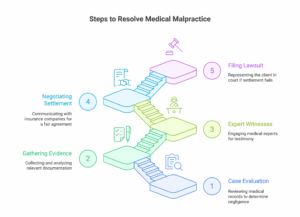
- Case evaluation: Reviewing your medical records and consulting with medical experts to determine if negligence occurred.
- Gathering evidence: Obtaining and analysing medical records, witness statements, and other relevant documentation.
- Expert witnesses: Engaging qualified medical experts to testify about the standard of care and how it was breached.
- Negotiating with Insurance Companies: Communicating Effectively and Negotiating a Fair Settlement.
- Filing a lawsuit: If a settlement cannot be reached, we will file a lawsuit and represent you in court.
Proving Medical Negligence: Key Legal Elements
To successfully pursue a medical malpractice claim, you must prove four essential elements:
- Duty of care: A doctor-patient relationship existed, establishing a duty of care.
- Breach of duty: The healthcare provider’s actions fell below the accepted standard of care.
- Causation: The breach of duty directly caused your injuries.
- Damages: You have suffered actual damages, including medical expenses, lost wages, and pain and suffering.
It is crucial to understand that proving these elements often requires expert medical testimony, adding to the complexity of medical negligence cases.
Navigating the Legal Process: What to Expect When Filing a Medical Malpractice Claim
Filing a medical malpractice claim involves several steps:
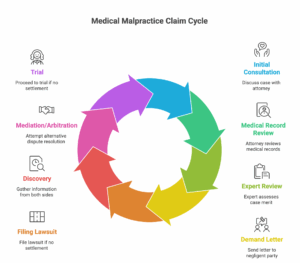
- Initial Consultation: Meeting with an attorney to discuss your case.
- Medical Record Review: The attorney reviews your medical records.
- Expert Review: A medical expert reviews your records to determine merit.
- Demand Letter: If the case is deemed meritorious, a demand letter is sent to the negligent party.
- Filing a Lawsuit: If a settlement cannot be reached, a lawsuit is filed.
- Discovery: Both sides gather information through interrogatories, depositions, and document requests.
- Mediation/Arbitration: Attempting to resolve the case through alternative dispute resolution.
- Trial: If a settlement cannot be reached, the case proceeds to trial.
Remember that each state has a statute of limitations, a deadline for filing a medical malpractice lawsuit. Missing this deadline will bar your claim, so prompt action is crucial. The specifics of these deadlines vary greatly, adding another layer of complexity.
Securing Compensation: Damages Recoverable in Medical Malpractice Cases
If you successfully pursue a medical malpractice claim, you may be entitled to compensation for various damages, including:
- Medical expenses: Past and future medical bills related to the injury.
- Lost wages: Past and future lost income due to the injury.
- Pain and suffering: Compensation for physical pain, emotional distress, and loss of enjoyment of life.
- Rehabilitation costs: Costs associated with physical therapy, occupational therapy, and other rehabilitation services.
- Punitive damages: In some cases, punitive damages may be awarded to punish the healthcare provider for egregious negligence. These are less common and depend on specific state laws.
Finding the Right Medical Lawyer: Expertise and Experience Matter
Choosing the right medical negligence attorney is critical to the success of your case. Look for an attorney who:
- Specialises in medical malpractice: They possess in-depth knowledge of medical terminology, procedures, and legal precedents.
- Has a proven track record: Review their case results and testimonials to assess their success rate.
- Possesses strong communication skills: They can clearly explain complex legal and medical issues to you.
- They are compassionate and empathetic, understanding the emotional toll of medical malpractice and treating you with respect.
- Offers a free consultation: A consultation allows you to discuss your case and determine if the attorney is a good fit.
Dealing with the aftermath of medical negligence is overwhelming. An experienced medical malpractice attorney can provide the guidance and support you need to protect your rights and seek the compensation you deserve.