Suffered an injury due to someone else’s negligence? You’re likely wondering what comes next. This guide breaks down the two main paths in a personal injury case: settling and going to trial. We’ll examine the pros, cons, and key considerations to help you make the best decision for your specific situation.
Personal Injury Case: Understanding Your Options
After an accident – a car crash, slip and fall, or workplace incident – you may be entitled to compensation. This compensation aims to cover your medical bills, lost earnings, and pain and suffering. To recover this, you’ll typically make a claim against the responsible party (or their insurance company). The process typically begins with submitting a demand letter that outlines your injuries and losses. From there, things can proceed down two different paths: settling out of court or preparing for trial.
The Allure of Settlement: Why Most Cases Settle
Settlement means reaching an agreement with the other party outside of a courtroom. It involves negotiation, potentially with the assistance of a mediator (more on that later!), to arrive at a mutually acceptable compensation figure. The vast majority of personal injury claims (over 90%, according to recent UK government data) end in settlement. Why?
- Speed and Certainty: Settlement offers a quicker resolution than a trial, avoiding potentially lengthy court delays. It also guarantees a specific outcome, eliminating the risk of losing at trial.
- Reduced Costs: Trials are expensive. Legal fees, expert witness costs, and court fees can quickly add up. Settling often means lower overall expenses.
- Privacy: Court proceedings are public records. Settlements, on the other hand, can be kept confidential, protecting your privacy.
However, accepting a settlement might mean receiving less compensation than you could potentially win at trial. It’s a trade-off to consider.
Preparing for Trial: Building a Strong Personal Injury Case
If a fair settlement can’t be reached, the next step is preparing for trial. This involves a process called “discovery,” where both sides gather information and evidence. Expect the following:
- Interrogatories: Written questions that you and the other party must answer under oath.
- Document Requests: Requests for relevant documents, such as medical records, police reports, and financial statements.
- Depositions: Oral examinations where you and witnesses answer questions under oath, recorded by a court reporter.
Building a strong case also requires identifying and preparing your witnesses, including expert witnesses. These experts (medical professionals, accident reconstruction specialists, etc.) can provide crucial testimony to support your claim.
Trial Time: What to Expect in the Courtroom
Going to trial can be intimidating. Here’s a simplified overview:
- Opening Statements: Each side presents their case.
- Presentation of Evidence: You and the other party present evidence, including witness testimony and documents. Remember, in personal injury cases, you (the claimant) bear the “burden of proof.” This means you must prove, on the balance of probabilities, that the other party was negligent and that their negligence caused your injuries.
- Closing Arguments: Each side summarizes their case and argues why they should win.
- Jury Deliberation: If a jury is present, they’ll deliberate in private to reach a verdict.
- Verdict: The jury (or judge, in a bench trial) announces the decision.
A successful trial can result in a higher payout than a settlement offer. However, it’s essential to remember that there’s no guarantee of victory.
Weighing the Pros and Cons: Settle vs. Trial in Your Personal Injury Case
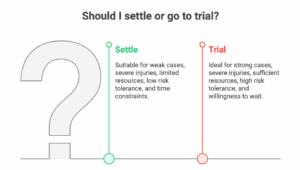
To help you decide between settling and going to trial, consider these factors:
- Strength of your case: How strong is the evidence of the other party’s negligence? A weak case might be better suited for settlement.
- Severity of your injuries: More severe injuries typically warrant a higher settlement or trial award.
- Financial resources: Can you afford the costs of a trial?
- Risk tolerance: Are you comfortable with the uncertainty of a trial verdict?
- Time constraints: Are you willing to wait for a trial?
When to Settle: Identifying a Fair Settlement Offer
How do you know when a settlement offer is fair? Consider these points:
- Medical expenses: The offer should cover all past and future medical costs related to your injuries.
- Lost earnings: The offer should compensate you for lost wages, both past and future.
- Pain and suffering: This is more subjective but should reflect the severity and impact of your injuries on your life. In the UK, guideline figures from the Judicial College Guidelines are often used to assess pain and suffering.
- Legal advice: Critically discuss any offer with your solicitor. They can advise you on its fairness, taking into account the specifics of your case.
For example, in a car accident case where the claimant suffered a broken leg that required surgery and extensive physiotherapy, and lost three months of work, a fair settlement offer would cover all medical expenses, lost wages, and an amount for pain and suffering proportional to the severity of the injury.
Settlement vs. Trial: Maximising Your Compensation in a Personal Injury Case
Ultimately, the decision to settle or go to trial is a personal one. There is no single “right” answer. Alternative dispute resolution (ADR) methods, such as mediation and arbitration, can be helpful stepping stones. Mediation involves a neutral third party facilitating negotiations. Arbitration involves a neutral arbitrator making a binding decision. If a settlement isn’t possible, you can still appeal if you think the result was unfair. Getting good legal advice is important. Your solicitor will guide you through the options, helping you decide what’s best to maximise your compensation.